Graham Coxon began his solo career while still serving as guitarist for Blur, but really hit his stride after leaving the group in 2002. His 2004 album, Happiness in Magazines, was a widely acclaimed collection of melodic guitar rock that announced his arrival as a fully formed solo artist, and he embarked on a full-fledged U.S. tour behind it.
The set focused heavily on the current album, including the singles "Bittersweet Bundle of Misery," "Freakin' Out," and "Spectacular," with a few older tunes, including the opener "Escape Song." It was a night of good songs in a casual atmosphere, but the venue could have been better. The Double Door's usual crew of meat marketeers was there, more interested in scoping out the talent in the crowd than the talent onstage.
"Do you like Blur?" one drunken soul asked my friend and me. Um, yes, although that hardly seemed relevant since this was a Graham Coxon solo gig, not Blur's. His next line has become a favorite of mine: "Oh. I thought maybe you were here with your boyfriends or something."
Coxon hasn't done a proper U.S. tour since then, and his stateside audience has remained limited although he's continued to release strong albums. C'mon, Coxon: You bring the striped shirts, we'll bring our boyfriends.
Showing posts with label Chicago. Show all posts
Sunday, October 28, 2012
Graham Coxon: March 25, 2005
Labels:
Blur,
Britpop,
Chicago,
Double Door,
Graham Coxon
Monday, August 20, 2012
Oasis: April 18, 2000
This appears to be my first concert as a Chicagoan! I got tickets to see this show with a friend but ended up reviewing it for a local entertainment paper and they reimbursed me. Ah, the few but nice perks of music journalism.
Oasis were already showing the signs of wear and tear by this point (including significant lineup changes), when they were promoting their fourth album, the grammatically confused Standing on the Shoulder of Giants. Although the album contained much of loping, Beatlesque sound one would expect, it was a bit darker and wearier in tone, particularly on the songs on which Noel Gallagher took the lead. It also contained a Liam Gallagher composition, a saccharine tribute to his then-wife's son.
Back then it would have been logical to expect one of two scenarios at an Oasis concert: They'd be drunk and arguing, or they'd put on a helluva rocking show. In fact, neither scenario transpired. Instead, it was a professional, competent, but fairly boring performance. Liam even politely applauded when his brother sang his trademark "Don't Look Back in Anger."
The set focused fairly equally on the then-current album and the two mega hits, Definitely Maybe and (What's the Story) Morning Glory? but was noticeably short on material from the oft maligned Be Here Now. Travis, at the time the "next big thing" coming out of the UK (boy, that ended fast) opened the show with a cheerfully anthemic set.
Oasis were already showing the signs of wear and tear by this point (including significant lineup changes), when they were promoting their fourth album, the grammatically confused Standing on the Shoulder of Giants. Although the album contained much of loping, Beatlesque sound one would expect, it was a bit darker and wearier in tone, particularly on the songs on which Noel Gallagher took the lead. It also contained a Liam Gallagher composition, a saccharine tribute to his then-wife's son.
Back then it would have been logical to expect one of two scenarios at an Oasis concert: They'd be drunk and arguing, or they'd put on a helluva rocking show. In fact, neither scenario transpired. Instead, it was a professional, competent, but fairly boring performance. Liam even politely applauded when his brother sang his trademark "Don't Look Back in Anger."
The set focused fairly equally on the then-current album and the two mega hits, Definitely Maybe and (What's the Story) Morning Glory? but was noticeably short on material from the oft maligned Be Here Now. Travis, at the time the "next big thing" coming out of the UK (boy, that ended fast) opened the show with a cheerfully anthemic set.
Sunday, July 22, 2012
The Donnas: March 23, 2001
This was my second Donnas show, the first being in Detroit in 1999. On the second date, the female foursome was supporting the accurately titled The Donnas Turn 21. Indeed, they'd begun playing together as middle schoolers and at last were hitting the age at which some of the things they sing about are legal. Bratmobile, an original riot grrl band of the early '90s that had recently reunited and released a new album, opened the show. They were fun, enthusiastic, and aptly enough, kind of bratty.
Despite playing a simple brand of straight-up rock influenced by punk and metal, the Donnas were pretty adept musicians by this point. They played several songs from the current album, including "40 Boys in 40 Nights," which, they explained in their introduction, is about exactly what you'd expect -- a typical rock 'n' roll tale of on-the-road debauchery, only with the usual genders reversed.
Bassist Maya Ford, a.k.a. Donna F., interacted most with the audience. Her non sequiturs, screeched in a fashion reminiscent of Vince Neil or maybe Spinal Tap, were charmingly hilarious. "I had some Krispy Kreme doughnuts this morning!" she yelled at one point. "Does anyone out there like Krispy Kreme? Let me hear you if you like doughnuts!" It was (pardon the pun) kind of sweet.
Wednesday, July 11, 2012
The Bangles: September 26, 2000
When the Bangles first crawled
up the charts in 1984 with "Hero Takes a Fall," their lovely
all-female harmonies seemed steeped in nostalgia for the 1960s. When the group reunited a decade after their breakup, however, it was 1980s nostalgia that was in full force.
The foursome commenced their
set with a hard-rocking rendition of Simon and Garfunkel's "Hazy Shade of
Winter," a big hit for the Bangles in 1987. The Bangles made a career of
combining well-chosen covers with original songs, a pattern that was naturally reflected in their live set. In addition to covers they recorded in
the '80s, such as "Live," "Going Down to Liverpool," and
"September Gurls," the group turned out a fabulous acoustic version
of "You Were on My Mind" and a surprisingly ass-kicking "Pushin'
Too Hard," one of few reminders that, before they were cute hit-makers,
the Bangles were a rock band well-versed in their Nuggets.
Of course, they also performed their crowd-pleasing
originals, including "Hero Takes a Fall," "Manic Monday,"
"Walk Like an Egyptian," "In Your Room," and the sappy
classic "Eternal Flame." They also played several tracks from the reunion album that was in the works at the time (Doll Revolution was released in 2003), usually prefaced with an apology to the audience. The
crowd's reaction to the new material was generally positive though, even if
the cheers became less enthusiastic as the night progressed.
Looking not much older than they did in their heyday, Vicki
Peterson, Susanna Hoffs, Michael Steele, and Debbi Peterson seemed to be having
a great time and, unlike so many other reunited groups, genuinely enjoying each
other's company. There were lots of casual moments, such as when Steele joked
that the light crew took a long time to spotlight her because they had no idea
which one she was, or when Vicki Peterson announced that the band were about to
play a Ricky Martin song as the synthesized backing track for "Going Down
to Liverpool" began. A good time seemed to be had by all, including those on-stage.
Labels:
Bangles,
Chicago,
Debbi Peterson,
House of Blues,
Michael Steele,
Susannah Hoffs,
Vicki Peterson
Tuesday, July 3, 2012
Graham Parker: June 2, 2007
Graham Parker has covered the bases, from pub rocker to Elvis Costello doppelgänger to alt country crooner. A formidable songwriter enjoying a resurgence on Chicago's venerable Bloodshot label, Parker was supporting his then-newest release, Don't Tell Columbus, with two intimate sets. Unfortunately, I attended the later set and found it to be a bit too intimate, resulting in one of the most embarrassing experiences I've had at a concert.
Despite Parker giving his all to material from his new album as well as classics from his late '70s/early '80s heyday, I kept nodding off. That's absolutely not a reflection of his performance, but my insane, early-bird schedule. The worst part? We were at tables in the front row. Rarely have I felt like such a jerk.
Monday, July 2, 2012
The Cramps: October 23, 2004
Rockabilly/horror proponents the Cramps made their way to Chicago's Vic Theatre just in time for Halloween. Their rarities compilation How to Make a Monster had recently dropped and I was somehow involved in giving it some ink (my feeble brain can't recall if I wrote about it or, as an editor, assigned a review to someone) so I was able to score complimentary tickets to the show. I'd always wanted to see the Cramps live, especially since a friend told me about someone breaking a liquor bottle over another person's head at a Detroit show he'd once attended. Now that's rock and roll!
As a matter of fact, that same friend was at this Chicago show, doing some tech work for the opening act, the Gore Gore Girls. And it's a good thing, too. Knowing the Cramps' image and the story about the bottle, I'm not sure what possessed me to show up in a dress and ballet flats, but I did. Here's what I wrote at the time:
"Little did I realize what being up front during a Cramps show entailed. We ended up in the heart of an old-fashioned mosh pit, the likes of which I had not seen since my teen years. We were terrified. When some middle-aged guy offered to help keep people off me, I told him, 'I'm too old for this!' He replied, 'You're too old for this? I saw them play 20 years ago!'
"Eventually [my friend from Detroit] rescued us and got us into a box above the stage, where we could watch the rest of the show in peace. From up there, I could see that the guy whose feet I'd seen sailing through the air as he bodysurfed throughout the show was not wearing pants. It was a fun show, and the Cramps played a lot of old stuff like 'Tear It Up,' 'TV Set,' 'The Way I Walk,' 'Mystery Plane,' etc."
It was a crazy but fun night, and when I heard the band's lead singer, Lux Interior, had passed away in February 2009, I was especially glad I'd had the chance to experience it.
As a matter of fact, that same friend was at this Chicago show, doing some tech work for the opening act, the Gore Gore Girls. And it's a good thing, too. Knowing the Cramps' image and the story about the bottle, I'm not sure what possessed me to show up in a dress and ballet flats, but I did. Here's what I wrote at the time:
"Little did I realize what being up front during a Cramps show entailed. We ended up in the heart of an old-fashioned mosh pit, the likes of which I had not seen since my teen years. We were terrified. When some middle-aged guy offered to help keep people off me, I told him, 'I'm too old for this!' He replied, 'You're too old for this? I saw them play 20 years ago!'
"Eventually [my friend from Detroit] rescued us and got us into a box above the stage, where we could watch the rest of the show in peace. From up there, I could see that the guy whose feet I'd seen sailing through the air as he bodysurfed throughout the show was not wearing pants. It was a fun show, and the Cramps played a lot of old stuff like 'Tear It Up,' 'TV Set,' 'The Way I Walk,' 'Mystery Plane,' etc."
It was a crazy but fun night, and when I heard the band's lead singer, Lux Interior, had passed away in February 2009, I was especially glad I'd had the chance to experience it.
Labels:
Chicago,
Cramps,
Detroit,
Gore Gore Girls,
psychobilly,
Vic Theatre
Thursday, June 28, 2012
Jah Wobble: May 11, 2001
Jah Wobble is a much more exotic moniker than the man's given name, John Wardle. The stage name is also a better fit for the music he creates. Starting off as the bass player in the most respected and influential version of John Lydon's post-Pistols group, Public Image Ltd., as a solo artist Wobble has experimented with sounds from around the globe. His biggest commercial success came with the 1991 album Rising Above Bedlam and the Sinéad O'Connor duet "Visions of You."
In 2001 Wobble embarked on a very brief U.S. tour (just five cities) in support of his album Passage to Hades with a group dubbed Deep Space. The opener was Chicago's 8 Bold Souls, a respected jazz ensemble that nicely complemented Wobble's worldly, experimental sounds.
The porkpie-topped Wobble and his band, which included keyboards and winds, were all business. Of course, part of the lack of stage banter was due to the nature of the music. Here's what I wrote in a blog just after the show:
Saw Jah Wobble at the Double Door with ----. He played one song for the entire show. Good, sexy music, but not exciting to watch. The highlight was the bad white people going "native" with their dancing. At one point, ---- turned to me and said, "I feel like Chicken Tonight."
So, yeah. Droning, experimental sounds that looped and loped into each other for about an hour or 90 minutes. And then a cheerful and sincere-sounding "thanks" and off he went. Being a sucker for a good hook, I guess I'd have preferred to hear more pop-structured songs, but I admire Wobble's experimentation and musicianship and am glad I got to see one of his rare American appearances.
Labels:
8 Bold Souls,
Chicago,
Deep Space,
Double Door,
Invaders of the Heart,
Jah Wobble,
John Lydon,
Johnny Rotten,
PiL,
Public Image Ltd.
Thursday, June 21, 2012
Badly Drawn Boy: May 6, 2001
The career of Badly Drawn Boy (or Damon Gough, as he was born) started with a bang but has since trudged along in a fairly low key. After a few EPs, he caused a sensation with his full-length debut, The Hour of Bewilderbeast, in 2000. Since then Badly Drawn Boy has gone back and forth between releasing soundtracks and albums under his own moniker, working steadily but never quite generating the excitement or adulation he did with Bewilderbeast.
It was while riding that early momentum, which included winning a prestigious Mercury Music Prize in his native U.K., that Gough visited Chicago in May 2001. To give an idea of his profile at the time, consider that the Metro holds 1,150 patrons and seemed to be sold out or fairly close. (By comparison, he played a 500-capacity Chicago venue in December 2010.) I really had no idea what to expect, but figured that the show might be worthwhile, given all the buzz. And indeed it was.
Like the epic yet lo-fi music on Bewilderbeast, the gig managed to feel simultaneously large and small. The room contained the presence and energy of a large crowd but the intimacy and good humor of a small one. Gough was a compelling presence, an incongruous blend of confident singer/songwriter and genial dude next door. Also incongruous was his chain smoking while singing in a clear, pretty folk voice. Donning his ever present scruffy beard, wool cap, and cigarette, he created an approachable persona that made the mid-sized venue seem more like an intimate club.
It was a long show with lots of songs (quite lovely ones, too) and banter. At one point, Gough passed around a photograph of his newborn daughter. After passing through a thousand hands, the photo amazingly made its way safely back to him onstage. Sometimes people surprise you in the best ways, and that unexpected positivity is what I remember most when thinking back on this show.
It was while riding that early momentum, which included winning a prestigious Mercury Music Prize in his native U.K., that Gough visited Chicago in May 2001. To give an idea of his profile at the time, consider that the Metro holds 1,150 patrons and seemed to be sold out or fairly close. (By comparison, he played a 500-capacity Chicago venue in December 2010.) I really had no idea what to expect, but figured that the show might be worthwhile, given all the buzz. And indeed it was.
Like the epic yet lo-fi music on Bewilderbeast, the gig managed to feel simultaneously large and small. The room contained the presence and energy of a large crowd but the intimacy and good humor of a small one. Gough was a compelling presence, an incongruous blend of confident singer/songwriter and genial dude next door. Also incongruous was his chain smoking while singing in a clear, pretty folk voice. Donning his ever present scruffy beard, wool cap, and cigarette, he created an approachable persona that made the mid-sized venue seem more like an intimate club.
It was a long show with lots of songs (quite lovely ones, too) and banter. At one point, Gough passed around a photograph of his newborn daughter. After passing through a thousand hands, the photo amazingly made its way safely back to him onstage. Sometimes people surprise you in the best ways, and that unexpected positivity is what I remember most when thinking back on this show.
Thursday, June 14, 2012
Donna Summer: August 30, 2008
Ravinia is a scenic outdoor venue north of Chicago where the elaborate picnics of those with lawn seats are just as much of an attraction as the artist who happens to be playing. In fact, from most spots on the lawn the picnickers are all you see, as the stage is completely out of view. Usually my friends and I will retreat to an area behind the pavilion briefly so that we can at least catch a glimpse of the performers. The lawn is a lovely sight, though, where far from "roughing it," people bring tablecloths, candelabras, real silverware and wine glasses, and elaborate foods. Behind the genteel facade, however, tensions are sometimes ready to bubble over. Maybe it's because of the venue's negative aspects: The lawn is oversold and overcrowded; because of the obstructed view, the lawn sometimes attracts partiers rather than people there to see the bands; the Metra trains that many patrons use to get home are overcrowded and prone to delays; people get really drunk.
On the way home from this show we were trapped on the top level of a very crowded Metra train with a few dozen boozy fifty-something women. Frankly, they scared me a little. Still slamming down vodka on the train, they apparently weren't the only ones at the show to get a little rowdy. The next day a news story appeared saying that two parties of picnickers had gotten into fisticuffs when one tried to steal the other's picnic space. It's not everyday you see the headline "Brawl At Ravinia" on the Huffington Post, but it is everyday (at least in the summer) that you can see patrons scrambling to claim space on the Ravinia lawn.
But when, you may ask, are you actually going to talk about Donna Summer? Well, I figure a description of the patrons is valid since it's a big part of the concert-going experience, and in the case of a show from the Ravinia lawn, the patrons are pretty much the main attraction. As for La Donna, she was touring in support of what turned out to be her final studio album, Crayons. She performed some songs from it along with other "newer" (i.e. not disco) songs and the material went over well since it was mostly upbeat and danceable -- just what the crowd wanted. She also sang many of her big hits from the '70s and '80s including "I Feel Love," "Bad Girls, "Last Dance," and "She Works Hard for the Money." She looked great decked out in an evening gown (we ventured down to the "holding pen" for a peek) and her voice was just as smooth and powerful as ever.
Hearing the quality of Summer's vocals, it was like time had stood still. Seeing the middle-aged crowd freak out whenever she launched into another disco hit, however, it was clear just how much time had passed. Ravinia was a long way from Studio 54, but you could see some of the audience going back in time, if only in their minds, if only for a few minutes. Maybe it is only because of nostalgia, but disco has withstood the test of time. And Summer, as the queen of the genre, has too. When she passed away in May 2012, it was clear from the many tributes to her in the media and on the web that she had earned the respect that was denied for too many years to artists slapped with the "disco" label.
On the way home from this show we were trapped on the top level of a very crowded Metra train with a few dozen boozy fifty-something women. Frankly, they scared me a little. Still slamming down vodka on the train, they apparently weren't the only ones at the show to get a little rowdy. The next day a news story appeared saying that two parties of picnickers had gotten into fisticuffs when one tried to steal the other's picnic space. It's not everyday you see the headline "Brawl At Ravinia" on the Huffington Post, but it is everyday (at least in the summer) that you can see patrons scrambling to claim space on the Ravinia lawn.
But when, you may ask, are you actually going to talk about Donna Summer? Well, I figure a description of the patrons is valid since it's a big part of the concert-going experience, and in the case of a show from the Ravinia lawn, the patrons are pretty much the main attraction. As for La Donna, she was touring in support of what turned out to be her final studio album, Crayons. She performed some songs from it along with other "newer" (i.e. not disco) songs and the material went over well since it was mostly upbeat and danceable -- just what the crowd wanted. She also sang many of her big hits from the '70s and '80s including "I Feel Love," "Bad Girls, "Last Dance," and "She Works Hard for the Money." She looked great decked out in an evening gown (we ventured down to the "holding pen" for a peek) and her voice was just as smooth and powerful as ever.
Hearing the quality of Summer's vocals, it was like time had stood still. Seeing the middle-aged crowd freak out whenever she launched into another disco hit, however, it was clear just how much time had passed. Ravinia was a long way from Studio 54, but you could see some of the audience going back in time, if only in their minds, if only for a few minutes. Maybe it is only because of nostalgia, but disco has withstood the test of time. And Summer, as the queen of the genre, has too. When she passed away in May 2012, it was clear from the many tributes to her in the media and on the web that she had earned the respect that was denied for too many years to artists slapped with the "disco" label.
Labels:
Chicago,
disco,
Donna Summer,
Giorgio Moroder,
Ravinia Festival
Thursday, May 10, 2012
Gary Numan: October 26, 2010
I am a pretty unrepentant new wave fan. So when the opportunity to see a synth pioneer performing one of his classic albums in its entirety arises, you can count me in. Although I would probably rank Replicas (with Tubeway Army) as my favorite Gary Numan album, The Pleasure Principle, which Numan took on tour for its 30th anniversary, is pretty fantastic too.
I had a good laugh when the crew tested tambourine levels before the show. If you know the song "Cars," and I know you do, you can appreciate the importance of getting the tambourine right.
Despite the passing of years, Numan still had his trademark intensity (and eyeliner). He sounded great vocally and musically, particularly on the instrumental "Random." In addition to all the Pleasure Principle tracks, Numan and his band tore through other synth-pop classics like "Are 'Friends' Electric?" and "Down in the Park." They also touched on some of Numan's more recent songs, which are more industrial in nature and unfortunately sound dated already. That's hard to swallow from an artist whose best work sounded like it came from the future.
I had a good laugh when the crew tested tambourine levels before the show. If you know the song "Cars," and I know you do, you can appreciate the importance of getting the tambourine right.
Despite the passing of years, Numan still had his trademark intensity (and eyeliner). He sounded great vocally and musically, particularly on the instrumental "Random." In addition to all the Pleasure Principle tracks, Numan and his band tore through other synth-pop classics like "Are 'Friends' Electric?" and "Down in the Park." They also touched on some of Numan's more recent songs, which are more industrial in nature and unfortunately sound dated already. That's hard to swallow from an artist whose best work sounded like it came from the future.
Saturday, September 24, 2011
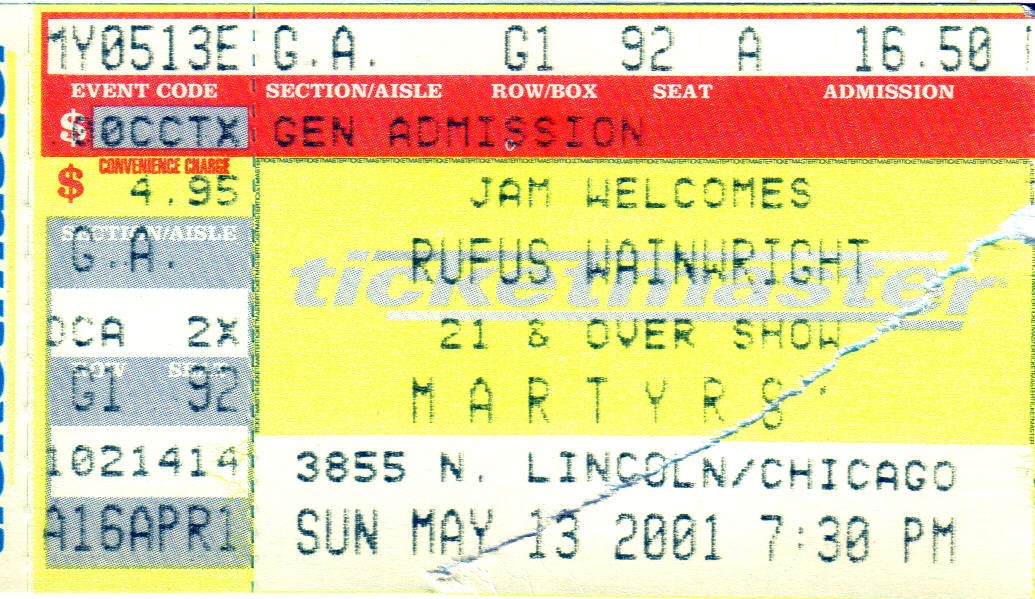
Rufus Wainwright: May 13, 2001
I've seen Rufus Wainwright several times, but this was the last show of his I really enjoyed. It took place at an intimate (and very crowded) venue before he started opting for the more lucrative but less enjoyable rounds of outdoor summer concerts and casino gigs. It also coincided with the release of my favorite of his albums, Poses. Rufus was in top form, giving a powerful but genial performance of songs from his first two releases. What I remember best, though, is the weird family dynamics on display that night.
The twin-sister duo of Tegan and Sara opened the show with a set more notable for their incessant sibling bickering than their songs. Later in the evening, Wainwright told the story of how he got thrown out of the gay bar Sidetrack the last time he was in Chicago. All feigned innocence, he insisted all he'd done was accidentally bump someone, causing him to spill a drink. The next thing you know, he was being roughed up by bouncers and tossed out on the sidewalk. (Knowing that Sidetrack is a decidedly non-tough bar and that Rufus was a hot mess during this period, I'm guessing this was not the most accurate version of events.) Rufus' sister Martha, who was singing backup for him, gently chided him that maybe that wasn't all that happened. They bantered back and forth for a minute before he gave up, declaring, "God, we're starting to sound like Tegan and Sara."
Such glimpses of personality were largely missing the next couple of times I saw him, in part because he played at outdoor summer festivals. To me, there's something about a person at a piano that calls for a smaller venue.
Labels:
Chicago,
Martha Wainwright,
Martyrs,
Rufus Wainwright
Subscribe to:
Posts (Atom)